Research unveils a new crocodile species, Herugavialis cairensis, found in limestone used for the Great Sphinx, shedding light on ancient marine life.
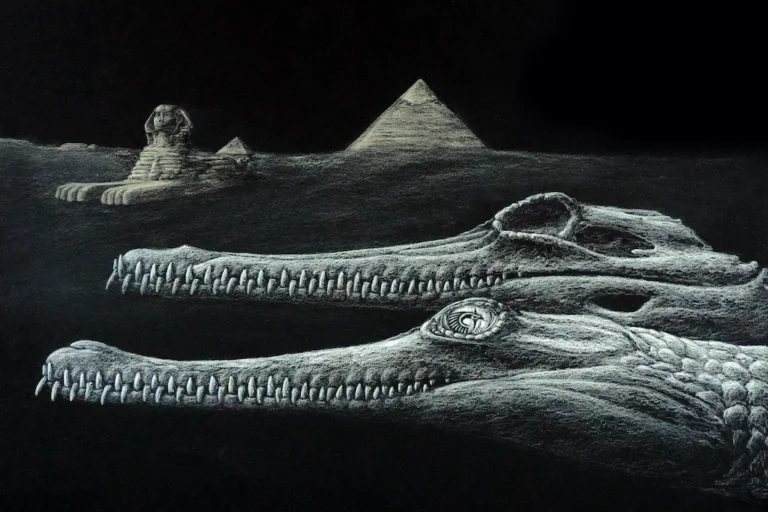
Approximately 45 million years ago, a crocodile with an elongated snout prowled the warm depths of a shallow sea in northern Egypt. Its remains ended up in the same limestone formations that would later be shaped by ancient Egyptians into the Great Sphinx. The identification of this creature as a new species, named Herugavialis cairensis, marks a noteworthy step in paleontological research. This discovery is documented in a recent study published in Royal Society Open Science.
A Nod to Mythology and History
The name Herugavialis cairensis pays tribute to the Egyptian god Heru, closely associated with kingship and the sky. This connection might evoke a sense of destiny; it coincides with the Great Sphinx, a monument that still captures the imagination of millions today. Ironically, like that legendary structure, the fossilized croc has a missing attribute—a nose—which aligns with the Sphinx's well-known deficiency. “Given this coincidence with the famously missing nose of the Great Sphinx, we decided to name the new crocodile after the Egyptian god Heru,” explained Philip Mannion, a paleontologist at University College London and a co-author of the study. There's more to this than just a clever name. It shows how paleontology can bridge ancient cultures with modern scientific endeavors.
The Journey of the Fossil
The fossilized remains, including a nearly intact skull, were originally collected in the 1920s from Egypt's Mokattam Formation. At that time, specimens like this often found themselves misclassified. They were placed under the genus Tomistoma—related to the living false gharial—simply due to their similar appearances. This mislabeling wasn't entirely unfounded; crocodilians can often be tricky to differentiate at a glance. However, that initial assessment failed to capture the uniqueness of the specimen.
But here’s the thing: the international research team's approach, featuring scientists from the U.K., Sweden, Germany, and Egypt, signals an important shift in how paleontological studies are conducted. Led by Paul Burke from the Swedish Museum of Natural History, they adopted advanced imaging technologies, such as CT scans, which allowed them to see not just the external features but also the internal structures of the skull. Such techniques are becoming increasingly standard in modern paleontology, offering insights that were impossible with traditional excavation and observation methods.
Analyzing Distinct Traits
Through CT scanning, the research team identified distinctive traits that separate Herugavialis from its false gharial relatives. This revelation underscores a broader understanding of the variations present among long-snouted crocodilians known as gavials. These creatures once roamed various regions across the globe, making the diversity of their evolutionary paths a significant point of interest among paleontologists. This isn't just a new name in taxonomy; it's a fresh perspective on how different species adapted to their environments over millions of years.
The Implications of Discovery
The implications of findings like this extend beyond mere classification. If you’re working in this space, you know how every fossil can paint a more intricate picture of the past. This research not only enriches our understanding of ancient ecosystems but also sparks discussions regarding climate changes and environmental shifts that led to the emergence of various species.
Adding a new species to the crocodilian family tree allows researchers to further explore evolutionary relationships. For instance, how did environmental factors affect their adaptations? This discovery opens avenues for examining the conditions that allowed for such diverse morphological traits. Such inquiries can inform scientists about resilience in other species, including those facing extinction today.
(And this is the part most people overlook.) This kind of research shines a light on the historical interplay between climate and biodiversity. As the Earth continues to face challenges, understanding these past dynamics may provide critical insights for current conservation efforts. This becomes increasingly relevant as we consider how various species might adapt (or fail to adapt) to ongoing changes.
Future Outlook
Looking ahead, this discovery could serve as a catalyst for further explorations in the field. With advances in technology, who knows what else paleontologists might uncover? If Herugavialis cairensis teaches us anything, it’s that our understanding of prehistoric life is still far from complete. As research progresses, we may find new connections between ancient and modern species, complicating our current models of evolution.
The study offers a reminder of the vibrant life that once existed on Earth and the many secrets still locked in the fossil record. As paleontologists endeavor to examine more specimens using modern techniques, discoveries like this will continue to reshape our understanding of Earth’s biological history. The significance of Herugavialis extends beyond its peculiar name; it invites us to reconsider what we think we know about ancient life on our planet.



Discussion
Sign in to join the discussion.