New research reveals the unique tail structure of the Iranian spider-tailed horned viper, shedding light on its hunting strategy and evolutionary traits.
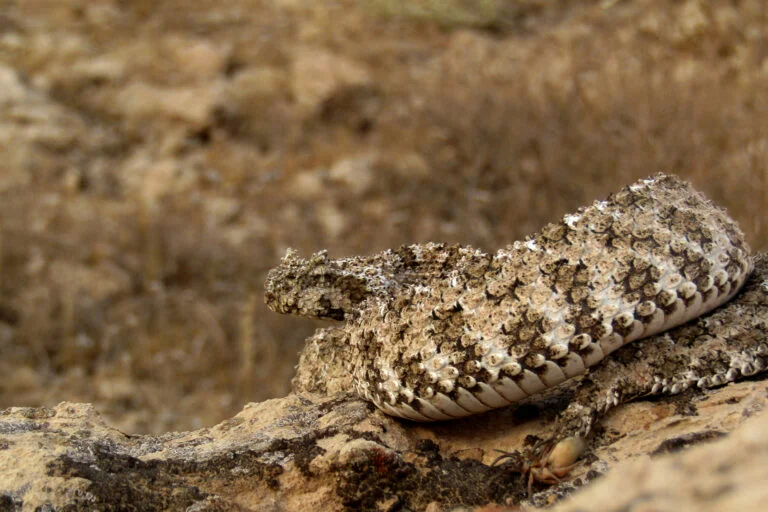
Understanding the Spider-Tailed Horned Viper
The Iranian spider-tailed horned viper (Pseudocerastes urarachnoides) is an extraordinary example of how adaptation can manifest in predator species. Found in the semi-arid regions of the Zagros Mountains, this rare snake employs an unusual hunting strategy that sets it apart from more well-known predatory reptiles. Instead of relying solely on speed or venom, it adopts a remarkably deceptive approach. The viper remains motionless, perfectly camouflaged in its surroundings, while its unique tail mimics the appearance of a spider. This clever ruse is designed to entice unsuspecting mammals and birds, luring them into striking distance. Predator adaptations like this are critical to survival in harsh environments. In the Zagros Mountains, where food can be scarce and conditions vary drastically, any edge can mean the difference between life and death. The spider-tail's movement—mirroring the erratic motions of a spider—adds an additional layer of intrigue and effectiveness to its predatory method. And yet, there's a significant gap in our understanding of how widespread such mimicry might be in the animal kingdom.
Research Insights
A recent examination of a specimen collected in 1968 has brought new focus to the anatomy of this elusive viper, now housed at the Field Museum of Natural History in Illinois. This research sheds light on the structural complexities that enable its remarkable hunting technique. Lead author Georgios Georgalis from the Polish Academy of Sciences emphasizes that the tail’s tip is distinctly crafted from enlarged and elongated scales, a feature that appears to have no comparable counterpart in any other living reptiles. This finding is not just a minor detail; it challenges existing paradigms in reptile morphology. Up until now, the anatomical variations in snakes have often been overlooked, largely due to a focus on more prominent features such as coloration and fang structure. Yet this study draws attention to the tail as a functional tool for survival, urging researchers to consider tail modifications in other reptiles as well. For those fascinated by herpetology, these insights into the spider-tailed horned viper signal a rich area ripe for exploration.
Evolutionary Implications
The publication of high-resolution 3D scans of the viper's tail is a noteworthy advancement in the field of snake research. Such technology allows scientists to analyze intricate anatomical details like never before. The viper's tail structure, while unique, exhibits traits that bear resemblance to certain ornithodiran archosaurs from earlier geological periods. But here's the thing: the similarities might be more a product of convergent evolution than a direct lineage connection. This suggests that disparate species facing similar environmental pressures can arrive at analogous evolutionary solutions, even if they’re not closely related. This function of mimicry demonstrates the wondrous complexity of natural selection at play. The fact that similar adaptations can occur across various taxonomic groups underlines an important principle in evolutionary biology: the environment plays a pivotal role in shaping the design and function of anatomical structures. As researchers delve further into this area, it may prompt a reevaluation of the evolutionary narrative surrounding these ancient reptiles.
This research underscores not only the biological complexities of reptilian life forms but also the ongoing intrigue surrounding these enigmatic predators. With a limited number of specimens to study, each new finding opens additional questions about how such species adapt in their natural habitats.
Implications for Future Research
The findings regarding the spider-tailed horned viper have significant implications for future research in both evolutionary biology and conservation. If you're working in this space, the concepts of mimicry and adaptive evolution highlighted here could reshape how we think about other species in similar environments. Understanding these adaptations may inform conservation efforts, especially in regions facing environmental challenges. As habitats continue to change due to factors like climate change and human encroachment, the resilience of species heavily relying on such specialized adaptations might be tested. It raises the question: will these remarkable evolutionary traits be enough to ensure their survival in increasingly inhospitable landscapes? The reality is that as species like the spider-tailed viper face mounting pressures, conservation strategies need to evolve just as rapidly to account for these unique adaptations. A comprehensive assessment of their habitat and prey dynamics—combined with a deeper understanding of their anatomical features—may shed light on how best to protect these fascinating creatures. After all, studying the spider-tailed horned viper isn’t just about understanding a single species; it’s a window into the intricate web of life that thrives in one of the world's less-explored ecosystems. In summary, this investigation reflects a compelling narrative of adaptation, evolution, and the necessity of ongoing scientific inquiry, emphasizing the importance of preserving such unique species for future study.



Discussion
Sign in to join the discussion.