In rural Uttarakhand, women’s household beekeeping supports native Indian honey bees amid habitat loss, climate change and other pressures.
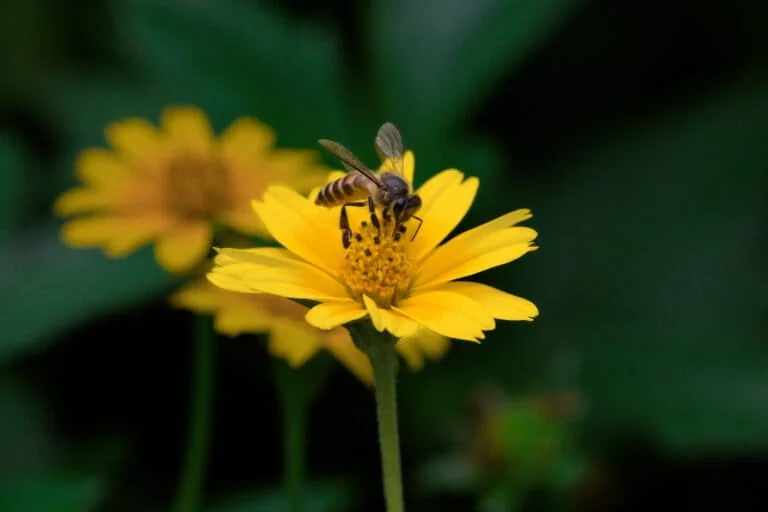
In rural Uttarakhand, native honey bees share space with families, and women are central to keeping that relationship alive. Saraswati Devi, 80, watches bees move through the opening of a wall hive in her courtyard in Pithoragarh, where the colony lives inside her home. The scene makes the relationship tangible: the hive isn’t a distant feature of the surrounding countryside but part of a household’s daily setting. That proximity also makes care practical and personal. When people and bees share a home, conservation is bound up with routines, knowledge and decisions made where families live.
“Bees are considered so sacred and an important part of people’s lives that we have faag songs about them,” she says. Faag are traditional songs performed at weddings and festivals in the Kumaon region. Saraswati and other women hum a wedding melody: “Bees come to those homes where children play; But at homes with no children, the bees won’t stay.” The song gives the bees a place in a community’s shared cultural life, linking their presence with family and celebration. It doesn’t establish why a colony settles in a particular home; its value lies in showing how people have made bees part of the stories they pass on. A species can be known through observation, but it can also be remembered through song.
Household ties under pressure
For generations, people in the region have lived alongside the Indian honey bee, Apis cerana indica, also known as the Himalayan honey bee. But its numbers are declining. Climate change, habitat fragmentation, insufficient nutrition and the arrival of other bee species introduced to increase honey production are among the pressures. The source identifies several causes, rather than pointing to a single explanation. That matters: when pressures accumulate, a response focused on only one factor may miss how changes in habitat, food and competition can affect the same population.
The contrast between a familiar household presence and a declining species is striking. A bee can remain visible in a courtyard while its numbers fall across a wider area; a colony at one home can’t, by itself, tell us how the species is doing throughout the region. That gap between what a household sees and what a population experiences is common in conservation. Local knowledge can help people recognize changes around them, while broader evidence is needed to understand their extent. The account offers no population figures, so the scale of the decline can’t be quantified here. The direction of concern, however, is clear.
The pressures listed also point to a difficult balance. Bees need suitable places to live and enough nutrition, while efforts to increase honey production can introduce other species into the same environment. The article doesn’t describe how those introductions affect native bees in particular locations, or whether every introduced species causes harm. It does identify their arrival as one pressure among several. That distinction keeps the problem in view without pretending that a complex ecological relationship has a simple, settled answer.
Women’s work as conservation knowledge
Because keeping bees is woven into household routines, women’s work puts them at the center of efforts to conserve the native species. Their role connects everyday care at home with the future of a bee that has long been part of life in Uttarakhand. This is more significant than it looks. Conservation is often described through forests, protected areas or scientific monitoring, but a species that lives alongside households also depends on the choices and knowledge present in those homes.
That doesn’t mean women alone can reverse the pressures described. Climate change and habitat fragmentation reach beyond any one household, and the account doesn’t claim otherwise. It does show why local participation matters: people who live with bees may notice their presence as part of ordinary life, not as an occasional research subject. Their observations and care can help keep the relationship visible. And this is the part most people overlook: cultural importance can support attention and continuity, but it can’t substitute for healthy habitat or adequate food.
For readers unfamiliar with household beekeeping, the wall hive is a useful reminder that human and insect life needn’t be separated into neat categories of “home” and “wild.” That arrangement may bring daily familiarity with a colony, along with practical responsibilities that the article doesn’t detail. It would be a mistake to assume every family in the region keeps bees in the same way. Saraswati’s courtyard offers a specific view into a broader relationship, not proof that every household shares an identical practice.
What the relationship means for the future
The account leaves important questions open. It doesn’t say how quickly the native bee is declining, how pressures differ from place to place, or what conservation measures are underway. Those gaps limit what can be concluded about the species’ prospects. They also make the everyday knowledge represented by Saraswati and other women more relevant, not less: a fuller picture would need to connect household experience with evidence about habitat, nutrition and the effects of other bee species.
If you’re working in this space, the lesson is to treat cultural ties and ecological conditions as connected parts of the story. A song can show what a community values; it can’t measure a population. A household hive can make conservation immediate; it can’t address habitat fragmentation on its own. The work requires attention at both scales, with local practices understood on their own terms and wider environmental pressures examined directly.
There’s a human dimension here, too. When a species has a place in the home and in songs sung at weddings and festivals, its decline can mean more than the loss of a source of honey. It can weaken a living relationship between families, place and the natural world around them. That’s not a claim that tradition alone will preserve the bee. It’s a reason to take the knowledge and care already present in households seriously, while asking what conditions the bees need to persist. The relationship is longstanding. Its future isn’t guaranteed.
This article was originally published on Mongabay.


Discussion
Sign in to join the discussion.