Elephants and whales can affect carbon storage through their bodies and ecosystems, but steep population losses complicate efforts to frame conservation as climate action.
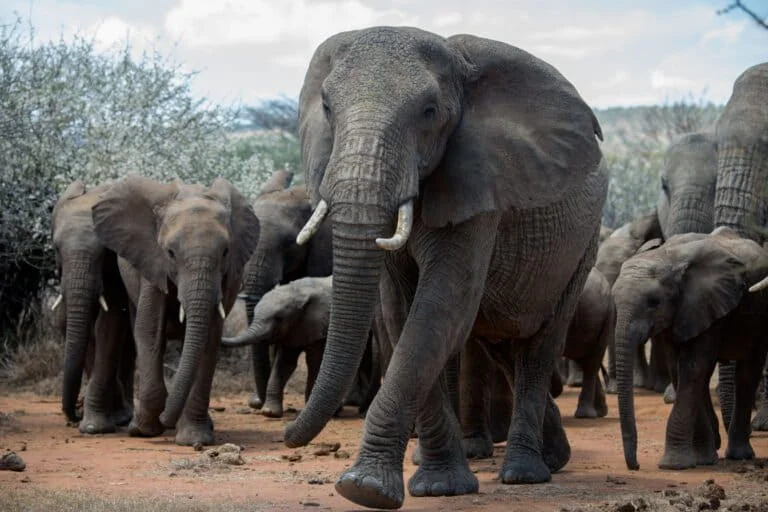
Elephants and whales may influence the climate through more than the carbon held in their bodies. Their effects on ecosystems—and the consequences of their decline—are drawing interest in restoring animal populations as a climate measure. The idea is intuitive: animals change the places they live, and those changes can affect how carbon moves through land and sea. But turning that observation into a climate strategy requires care. A species can matter to an ecosystem without its climate effect being easy to measure, or large enough to substitute for reducing emissions. The scale of past losses makes the idea difficult to separate from the broader case for protecting wildlife.
Elephant losses reshape the carbon question
Elephants once ranged across Africa in vast herds, shaping ecosystems and, research suggests, the continent’s carbon balance. Estimates of historical decline are uncertain, though some scientists suggest humans have eliminated 98% of Africa’s elephants over the past five centuries. The IUCN, a global wildlife conservation authority, put the continent’s population at 1.3 million in the 1970s. Later research indicates savanna elephants (Loxodonta africana) have since declined by 70%, largely because of hunting and habitat loss; forest elephants (Loxodonta cyclotis) may have fallen by 90%.
Those estimates describe different periods and populations, so they shouldn’t be collapsed into one simple account of loss. They do, however, show why a climate discussion about elephants begins with a much larger ecological disruption. When a large animal disappears from a region, the effects can extend beyond the number of individuals lost. Feeding, movement and other everyday activity can shape habitats over time, changing the conditions under which plants and soils store carbon. The precise result depends on the ecosystem, which makes broad claims about a single continent difficult to defend.
That uncertainty cuts both ways. It doesn’t erase the possibility that elephants affect carbon cycling; it means the size and direction of that effect need to be established rather than assumed. Researchers have to distinguish the carbon consequences of animal activity from other changes in land use and habitat. A comparison with a present-day ecosystem may also miss what a landscape looked like when animal populations were much larger. The missing animals are part of the question, but so is the changed environment they left behind.
This is more significant than it looks: the climate value of restoring elephants can’t be judged only by counting animals returned to a region. The question is whether their presence changes ecosystem processes in ways that can be observed and sustained. If you're working in this space, that distinction matters for setting expectations. Wildlife recovery can have ecological value even when its contribution to carbon storage remains difficult to quantify.
Whales affect carbon while alive and after death
Whales offer a different route to carbon storage. Their large bodies hold carbon for the decades or longer they live. Their nutrient-rich waste can also support phytoplankton, which absorb carbon dioxide—a process researchers have described as the “whale pump.” After death, some whales sink to the ocean floor, where deep-sea organisms feed on their bodies and the carbon remains out of the atmosphere.
These mechanisms operate at different points in a whale’s life. Carbon held in a body is tied to the animal remaining alive; the whale pump describes an effect mediated through nutrients and marine life; and a whale fall moves carbon into a deep-sea environment after death. They’re connected, but they aren’t interchangeable measures. An estimate that counts one pathway shouldn’t be treated as if it captures the others, and describing a mechanism doesn’t by itself establish its total climate impact.
Here's the thing: the whale example makes the climate connection tangible, but it also shows how easy it is to overstate what the connection proves. The presence of a biological pathway is a reason to investigate, not a ready-made calculation of climate benefit. And this is the part most people overlook: a whale’s ecological role doesn’t begin and end with carbon. Nutrient movement and the communities that feed on a whale after death are part of a wider set of relationships that may be disrupted when populations decline.
Restoration needs a measured climate case
The climate case for restoring large animals rests on these connections between wildlife and carbon cycling. Yet the evidence described here points to several mechanisms, not a single measure of climate benefit. Any push to rewild landscapes will need to account for both the ecological roles animals play and the scale of their decline.
That means keeping two arguments in view. The first is that elephants and whales may influence carbon storage and movement in ways that deserve serious study. The second is that their protection has a broader ecological case, one that doesn’t depend on promising a precise climate payoff. Conflating the two risks setting a standard that animal conservation can’t meet: a single carbon figure may not capture the value of a living population or the consequences of its loss.
There’s also a practical difference between restoring an animal population and restoring the conditions that allow it to thrive. The source evidence points to hunting and habitat loss as major drivers of elephant declines, while the whale discussion describes carbon pathways tied to living animals and their deaths at sea. Those are distinct challenges. Any restoration effort would need to account for the relevant pressures and ecological context before its climate contribution could be assessed. A population target alone wouldn’t tell the full story.
The evidence here is suggestive, not a settled accounting. That’s a reason to keep investigating the mechanisms and their limits, while treating conservation as valuable on its own terms. For readers, the useful takeaway is that large animals aren’t just passive stores of carbon: their lives and interactions can affect how ecosystems cycle it. The scale of that effect remains the harder question. Still, the possibility is worth taking seriously—carefully.
This article was originally published on Mongabay.



Discussion
Sign in to join the discussion.