A new conservation area covers part of northern Angola’s biologically rich Serra do Pingano, where forests have shrunk sharply over two decades.
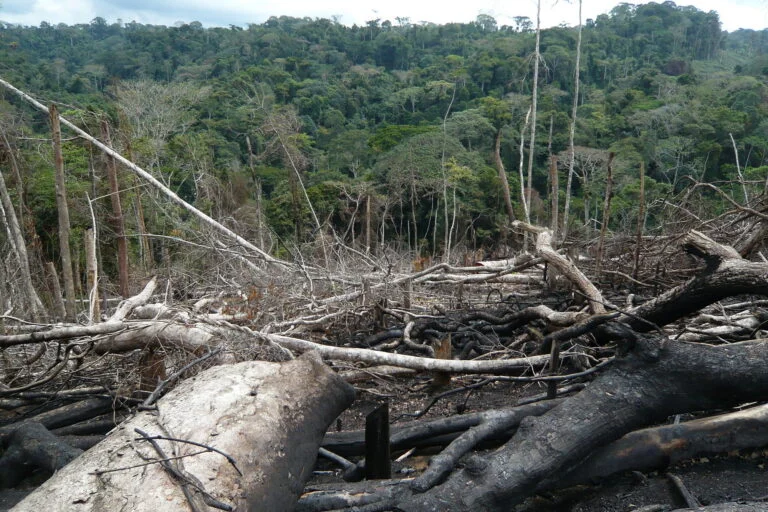
Angola established the Serra do Pingano Conservation Area in April after years of appeals to safeguard one of the country’s last significant tropical forest regions south of the Congo River. The designation comes amid steep declines: central Serra do Pingano lost 43% of its original forest cover over the past two decades, while the wider Serra do Pingano Forest Ecosystem (SPFE) lost 21%, or 536 square kilometers (207 square miles).
Those figures describe two different scales of loss. The sharper decline in central Serra do Pingano points to especially severe pressure in the area at the heart of the forest, while the wider SPFE measure shows that the damage extends beyond it. The distinction matters: a protected boundary can cover a large area on paper, but the ecological condition of its most affected parts will shape what protection can achieve.
Forest loss also changes more than the amount of tree cover visible in an image. As forests are cleared or divided, the habitats they provide can become harder for plants and animals to occupy and connect. The article gives no breakdown of the causes of the decline, so the figures don’t establish which activities are responsible. They do show that designation arrives after substantial loss has already occurred.
The findings appeared earlier this year in Nature Ecology & Evolution, in a study signed by 11 researchers from multiple institutions, including two Angolan authors. Drawing on years of research, the paper warns that the remaining forest is under pressure and calls for its protection.
The research gives the conservation area a clear rationale: the forest is both ecologically distinctive and diminishing. Years of work also suggest that the case for protection wasn’t based on a single snapshot. Still, research can identify urgency without resolving the practical questions that follow: how a designated area will be managed, how remaining habitat will be monitored, and whether the boundary can help limit further loss.
A meeting point for African ecosystems
The SPFE lies in Uíge province and includes several densely forested mountain ranges with high biological value. Serra do Pingano sits where tropical rainforest meets miombo savanna, linking elements of western Central African forests with species and evolutionary lineages associated with southern and eastern Africa.
That position gives the region significance beyond its forest cover alone. Ecological transition zones can bring habitats and biological communities into contact, creating a mix that may differ from the ecosystems on either side. In this case, the study describes connections among forest elements and lineages associated with several parts of Africa. The value of the area, then, rests partly in how those ecological relationships come together.
But a boundary between forest and savanna isn’t necessarily a stable line. The wider ecosystem includes mountain ranges and varied habitats, and its ecological character depends on the conditions that allow those habitats to persist. If you're working in conservation, that’s a reminder that a forest percentage can’t tell the whole story. The location and condition of what remains matter too.
This is more significant than it looks: protecting Serra do Pingano could help preserve a meeting point between ecological regions, not simply a patch of trees. And yet, the designation alone can’t demonstrate that those connections will endure. That depends on what happens to the remaining forest over time.
Protection begins with a designation
The new conservation area follows repeated calls to protect this ecological transition zone. The study’s co-author Thea Lautenschläger, a German ethnobotanist focused on northern Angola and scientific director of the Botanical Garden of Hamburg, discussed the forest’s threats and the species that depend on it in an interview with Mongabay.
The interview adds a human account to the research finding: the forest’s threats and its dependent species were important parts of the case for action. The source doesn’t specify the full range of those threats or identify particular species, so the evidence presented here can’t support a more detailed inventory. What it does establish is that researchers see the remaining forest as under pressure and consider its protection necessary.
Declaring a conservation area is a meaningful step, but it’s the start of a process rather than proof of an outcome. Similar protected areas depend on practical follow-through: clear management, attention to changes in habitat, and decisions that keep the stated conservation purpose active. Those are general conditions for protection to matter; the article doesn’t describe which arrangements Angola has put in place for Serra do Pingano.
(And this is the part most people overlook.) The conservation area’s value will be judged not just by its creation, but by whether the forest it covers remains intact and ecologically connected. A designation can recognize a place’s importance. It can’t, by itself, reverse the losses already recorded.
What the numbers can and can’t tell us
The reported losses are stark, but they need to be read with care. Central Serra do Pingano’s 43% decline and the SPFE’s 21% decline refer to different geographic scopes. The wider ecosystem’s loss of 536 square kilometers provides an area measure alongside the percentage, but it doesn’t explain where all that loss occurred or how it was distributed among the mountain ranges.
That limits what can be concluded from the figures alone. They establish the scale of past forest loss, while questions about its causes, pace, and local variation require evidence beyond what’s included here. The study’s call for protection is clear; the source doesn’t provide details that would allow readers to assess the conservation area’s management or predict how much additional loss it might prevent.
Still, the numbers make delay harder to defend. The remaining forest is already part of a shrinking ecosystem with a distinctive place in the region’s biology. A long-term view will require tracking whether forest cover is retained and whether the ecological links described by the researchers remain present. No guarantee. Just the measure of whether the designation is doing its job.
The test ahead
The designation marks a response to documented forest loss; its lasting value will depend on whether protection can help preserve what remains of this rare ecosystem. The original report was published by Mongabay.
For readers, the central point is straightforward: Angola has formally recognized the importance of a forest region that has already lost a substantial share of its cover. The next meaningful evidence will come from the condition of the forest after designation, not from the announcement itself. That said, formal protection matters because it creates a basis for sustained conservation work; whether that basis translates into lasting results remains the open question.

Discussion
Sign in to join the discussion.