Taliban officials will attend COP31 in Turkey for the second time since 2021, as Afghanistan faces drought and flooding.
Afghanistan’s climate risks return to the COP31 agenda
Afghanistan’s exposure to drought and flooding is putting the question of who speaks for the country back in focus as COP31 approaches. Taliban officials have been invited to attend the U.N. climate summit in Antalya, Turkey, as observers when it begins next week, Turkish and Kabul officials confirmed Tuesday. It will be their second attendance in that capacity since the Taliban returned to power in 2021.
The invitation creates a narrow opening for Afghan officials to be present in a forum where governments discuss climate risks and responses. Observer status can allow participation in some summit proceedings, but the article doesn’t specify what access the delegation will have or whether it will take part in particular discussions. That distinction matters: presence at a conference can make a government more visible without giving it the standing of a formally recognized state authority.
Observer status and the recognition dispute
The observer role does not amount to formal recognition by U.N. member states. That leaves the central political dispute intact. Severe restrictions imposed on women remain a principal reason the Taliban government isn’t recognized, and critics oppose recognition while those restrictions continue.
Climate diplomacy often has to contend with a practical problem: decisions and discussions concern people living in places whose authorities face international opposition. Excluding those authorities may limit their access to the negotiating process; admitting their representatives can, in turn, be read as conferring legitimacy. Here, the observer designation draws a boundary between attending the summit and receiving formal recognition, though it can’t resolve the argument over whether that boundary is sufficient.
And yet, a seat in the room still carries meaning. A voice at the talks, even a limited one.
Why representation matters for climate talks
Drought and flooding put different pressures on communities, infrastructure and public services. Drought can make access to water more difficult, while flooding can damage homes, roads and other systems people depend on. Climate negotiations address broad questions about how countries respond to such risks, but turning international discussion into action also depends on information and decisions connected to conditions on the ground.
That’s the argument made by those who say Afghans need a voice in climate talks. It isn’t the same as endorsing the government that attends. It’s a claim about representation: people facing climate hazards have interests that may go unheard if no one from their country can bring those conditions into the discussion. This is more significant than it looks, because the debate over who may speak can overshadow the people affected by the risks.
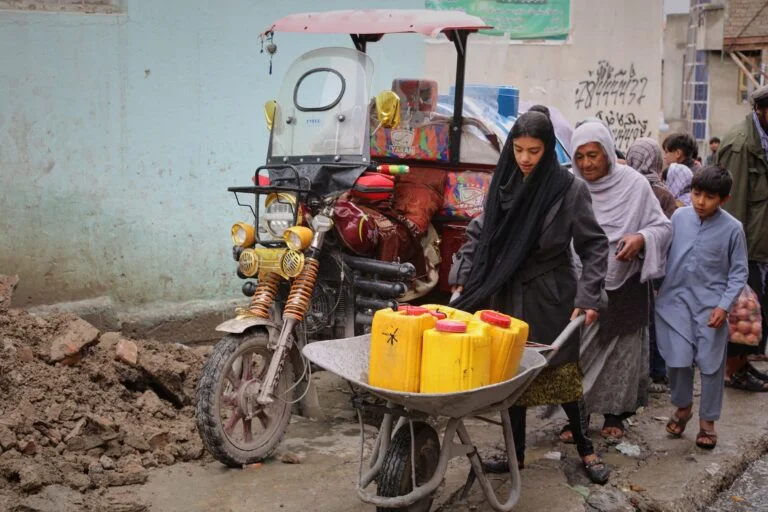
A photograph accompanying the report shows a girl carrying water jerrycans on a wheelbarrow after collecting water from a well at a mosque in Deh Mazang, Kabul. The image offers a specific glimpse of water access in one place; it doesn’t, by itself, describe the scale of drought or establish how climate conditions are changing. That distinction matters in climate coverage, where an individual scene can make a broad problem tangible without standing in for evidence about the whole country.
The limits of a second attendance
The confirmed invitation is a procedural development, not evidence that the recognition dispute is easing or that the summit will produce a particular outcome for Afghanistan. The article doesn’t say what the Taliban delegation plans to raise, what decisions it might influence, or how other participants will respond. Any stronger claim would go beyond what has been reported.
If you’re working in this space, the point to watch is how the summit handles the separation between participation and recognition in practice. (And this is the part most people overlook.) Observer access may put Afghan climate concerns into the room, but access alone doesn’t guarantee that those concerns shape negotiations or lead to concrete support. The gap between being heard and securing a response remains.
What this means for you as a reader is that two questions will travel together at COP31: how climate discussions can account for people in Afghanistan, and what conditions should apply when officials representing the Taliban are present. The invitation answers neither one outright. It puts both back before the summit.
By Victoria Milko, Associated Press. Banner image: A girl carries jerrycans on a wheelbarrow after collecting water from a well at a mosque in Deh Mazang, Kabul, Afghanistan, April 2, 2026. Image courtesy of Siddiqullah Alizai via Associated Press. This article was originally published on Mongabay.



Discussion
Sign in to join the discussion.