Gibbon trafficking seizures hit a record in 2025, while habitat loss and hunting continue to threaten the apes and their families.
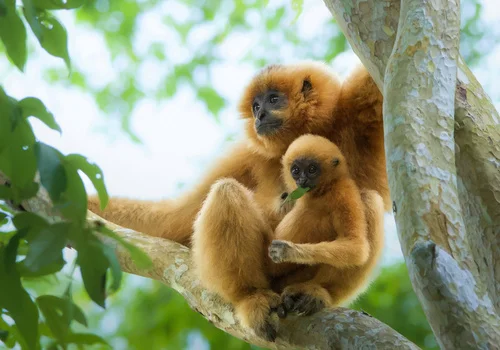
Gibbon trafficking reached a recorded high in 2025, with 336 individuals seized from January through August, according to Mongabay reporter Ana Norman Bermúdez. The figure puts a sharp focus on demand for infant gibbons in the exotic pet trade ahead of International Gibbon Day on Oct. 24. Seizure counts capture only animals authorities find, so they show the scale of documented cases rather than the full volume of trade. The reported high is a warning signal, though it doesn’t by itself explain whether trafficking increased, enforcement improved, or both.
That distinction matters. A seizure is an intervention, but it also marks an animal already removed from its forest and exposed to the risks of capture and transport. The number gives the public a concrete measure of the problem while leaving important questions unanswered: where the animals were taken, how they were moved, and how many survive. Those gaps make the individual stories especially relevant.
Why infant gibbons are targeted
Across Asia’s tropical forests, all 20 gibbon species face pressure from deforestation, hunting and trafficking. The pet trade often begins with the capture of a baby—and the loss of its family. Gibbons are small apes, more closely related to chimpanzees and humans than to monkeys. They’re highly social and defend their young fiercely, sometimes to the death.
That family bond helps explain why an apparently simple sale can carry consequences beyond one animal. Hunters seeking an infant may kill its mother, and the young gibbon then loses the care and social environment it would depend on in the wild. A pet buyer sees a small animal; the forest may have lost an adult and a dependent offspring, with wider effects on the family group. The trade’s appeal rests partly on the infant’s size and appearance, while the cost is borne by animals whose needs are poorly matched to life in a home.
Gibbons’ close relationship to humans and other apes can also be misunderstood as a reason they’d make suitable companions. It isn’t. Their social lives, movement and development are shaped by forest habitats and family groups, conditions a private household can’t reproduce. This is more significant than it looks: the demand for one appealing infant can create pressure to remove several members of a group.
Esther’s encounter with the trade
Esther, a Malaysian woman from Borneo who asked Mongabay to use a different name, encountered that trade without realizing it. A hunter visiting her village to sell wild meat showed her and her husband a weeks-old primate with long arms, dark skin and large eyes. Fearing it might be killed for food, Esther took the animal home. She later learned that Joy, as she named the gibbon, wasn’t a monkey.
Her decision began with concern for an animal in immediate danger, but the encounter also shows how trafficking can reach people who don’t set out to buy an exotic pet. A seller presented a vulnerable infant in a familiar village setting, and Esther acted on what she understood at the time. The story doesn’t establish what happened to the gibbon’s family or how the animal was obtained. It does show how easily the line between rescue and participation in the pet trade can become unclear when a buyer has little information and the animal is already in danger.
That ambiguity matters for readers, too. Compassion for a single animal is understandable, but buying or keeping a wild animal can create demand for more captures. If you’re working in this space, the distinction between helping an individual and reducing the incentive to take another infant is central to public messaging.
Rescue centers face the aftermath
Rehabilitation centers in North Sumatra are also confronting the toll of the trade, as trafficked baby gibbons arrive in large numbers. Hunters seeking infants often shoot their mothers, leaving young apes without the families they depend on.
Rescue is only the first stage of a much longer problem. An infant that has lost its mother and family needs specialized care, and rehabilitation centers must address the consequences of capture after the transaction has already taken place. The article’s account doesn’t specify the centers’ capacity or the prospects for each animal, so the scale of their challenge can’t be quantified here. Still, repeated arrivals point to a persistent burden: every case requires attention, while the conditions that produce new cases remain in place.
And this is the part most people overlook: a rescue can make a compelling story, but it doesn’t undo the loss that made rescue necessary. Centers can care for animals that reach them; preventing capture requires reducing the demand that gives hunters a reason to seek infants in the first place. A long chain of consequences.
What the record suggests
The stories shared for International Gibbon Day point to a direct cost of demand: each infant taken from the forest may represent the destruction of an entire family group. The 336 recorded seizures make that cost harder to treat as an isolated problem, while the cases described show how it can unfold—from a hunter’s offer to a household, then to the work of rehabilitation. That said, the available figures don’t reveal the total number of gibbons trafficked or the share of cases that authorities intercept.
What this means for you is that the headline number should be read as evidence of documented seizures, not a complete count of animals affected. The stories add human detail, but they also underline a harder point: when demand focuses on infants, the harm can extend well beyond the animal that reaches a buyer. International Gibbon Day offers a moment to examine that chain, though the measure of progress will be whether fewer gibbons are taken from their families. Mongabay



Discussion
Sign in to join the discussion.