Restoring wetlands and waterways in Białowieża could protect a threatened ecosystem while creating terrain that impedes military vehicles.
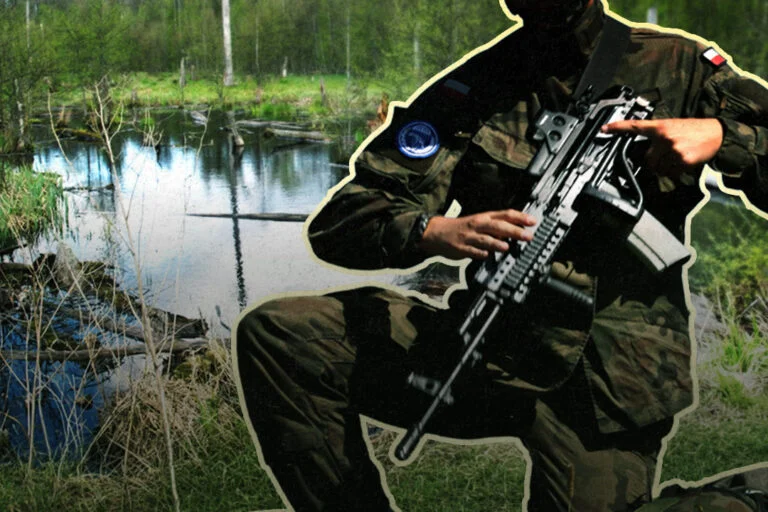
Białowieża Forest’s wetlands, rivers and dense growth could serve two purposes: sustaining one of Europe’s last primeval forests and creating terrain difficult for heavy vehicles and ground forces to cross. That possibility is informing debate over Poland’s East Shield border project, which brings military planning into direct contact with questions about the forest’s condition. The idea is not that trees or marshes can replace military infrastructure. It’s that the natural features already present may affect how forces move through the region—and that restoring those features could have consequences for both conservation and defense.
The forest spans the Poland-Belarus border and has been weakened by decades of drainage, drought and fragmentation. Poland is planning new military infrastructure and fortifications in the region as concerns about Russia and Belarus grow. That puts a difficult question on the table: how can the state address security concerns without adding to the pressures on a fragile ecosystem? Scientists warn that development around the forest could worsen existing ecological damage. The tension is practical as well as political, because decisions about roads, water and construction can shape the same terrain that military planners are considering.
Restoration as a defensive measure
Some scientists and conservationists propose restoring the forest, its wetlands and rivers to more natural conditions. Supporters call the approach “warwilding”: using restored landscapes as part of military strategy. The term describes an overlap between ecological restoration and defense planning, rather than a claim that conservation alone provides security. The Polish military has shown interest in nature’s defensive value and supports restoration in parts of the forest. That interest gives the proposal a foothold in a debate that might otherwise be framed only as a conflict between construction and environmental protection.
The obstacles are already built into the terrain. Hundreds of kilometers of drainage ditches carry water away, and roads cut through areas that might otherwise act as natural barriers. Reversing that damage would require coordination, funding and political will, conservationists say. Those requirements matter: restoring wetlands is not a single intervention with an instant result, but work that would have to account for existing infrastructure and the needs of people and institutions operating in the region. Their case is that restoration could strengthen the forest’s prospects for long-term survival while also serving a practical defensive purpose.
What restoration could change
Water is central to the proposal. Drainage ditches have altered how water moves through the forest, while rivers and wetlands are among the natural features supporters believe could make movement harder for heavy vehicles and ground forces. In general, wet ground, dense vegetation and waterways can complicate travel across terrain. The degree to which those features would affect military movement here isn’t established by the source, and the proposal shouldn’t be treated as a ready-made defense plan. It is a case for taking the landscape into account when planning both restoration and infrastructure.
That distinction matters. A restored ecosystem may support conservation goals even if its military value proves limited, while infrastructure decisions could affect habitats regardless of their strategic rationale. The two objectives may align in some places and conflict in others. Roads, for example, already cut through parts of the forest; any future work would have to consider whether it changes access, fragments habitat further or alters how water moves. The source doesn’t specify the design or location of planned works, so those effects can’t be assessed here.
And this is the part most people overlook: the proposal depends on treating ecological condition as a factor in security planning, not as scenery around it. (and this is the part most people overlook)
The limits of a shared purpose
“Warwilding” is an appealing idea partly because it offers a shared purpose to groups that may otherwise approach the forest from different directions. Conservationists want the ecosystem to recover; military planners have shown interest in terrain that could impede movement. But a shared label doesn’t resolve the hard choices. Restoration takes coordination, funding and political will, and infrastructure planning can still create pressure on the forest. If those decisions proceed separately, the two goals could collide even when both are described as serving the region.
This is more significant than it looks. The proposal asks planners to consider whether natural systems can contribute to defense while also needing protection from the consequences of development. That’s a more demanding standard than simply calling the forest a barrier. It requires attention to how drainage, roads and new construction interact with restoration, and to whether the military’s stated interest translates into support for changes on the ground.
What the debate means for the forest
If you’re working in this space, the useful question isn’t only whether wetlands and dense growth can impede movement. It’s whether restoration can be planned in a way that helps the forest persist while fitting the region’s security needs. The source offers no detailed plan or assessment of how effective restored terrain would be. That leaves important questions open, including how the proposed work would be coordinated and how its ecological and practical effects would be judged.
Still, the debate points toward a consequential choice. Poland’s East Shield planning is taking shape amid concerns about Russia and Belarus, while scientists warn that development could add to long-standing ecological damage. Restoration offers a possible way to connect those pressures, but it isn’t a shortcut around them. The forest’s future will depend on what gets built, what gets restored and whether those decisions account for the same land and water.
A complicated proposition. Potentially useful, but only if the practical work matches the promise.
This article was originally published on Mongabay.



Discussion
Sign in to join the discussion.