An IUCN assessment finds 24% of shallow-water coral reefs are already critically endangered, with climate-driven heat stress putting 96% at risk within 50 years.
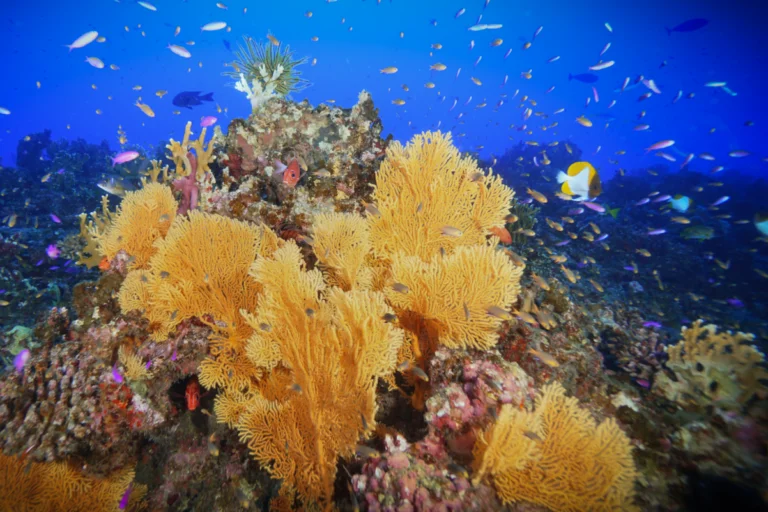
The scale of risk facing coral reefs is stark: 96% of the shallow-water ecosystems assessed could be critically endangered within 50 years if climate projections hold. The first coral reef review under the IUCN Red List of Ecosystems, released Oct. 22, found that 24% are already critically endangered. Those figures describe different points in the assessment: one is a projection conditional on climate scenarios, while the other reflects the present status of ecosystems assessed. That distinction matters. The warning isn't that every reef has already collapsed, but that the risk could become widespread if the conditions behind the projection persist.
More than 250 experts assessed reefs across 127 tropical and subtropical ecoregions, including Australia’s Great Barrier Reef and Southeast Asia’s Coral Triangle. The Western Galapagos Islands reef ecosystem has already collapsed, the assessment found. A review spanning many regions can show whether threats recur across different settings, though a global picture can't erase the local differences among reefs. Conditions, species and pressures vary from place to place. The collapsed ecosystem is a concrete example of the outcome the assessment is trying to track; the projected risk across other areas is a warning about what could follow, not a claim that all reefs face the same path.
Heat stress drives the decline
Climate-related heat stress emerged as the most consistent threat across regions. It can trigger coral bleaching, in which corals expel the symbiotic algae in their tissues. Those algae supply most of a coral’s food through photosynthesis. When bleaching lasts, corals weaken, become more vulnerable to disease and may die. The sequence helps explain why heat exposure can affect an entire ecosystem: damage to the coral's relationship with its algae can leave the coral with less energy at the very time it needs to recover. A bleaching event is a warning sign, but the source describes lasting bleaching as the more serious condition, because prolonged stress can push weakened corals toward disease and death.
Bleaching also makes the health of a reef harder to judge by a single observation. Corals that have expelled algae aren't necessarily dead, but the longer the stress continues, the more difficult recovery may become. The assessment identifies heat stress as a consistent threat; it doesn't mean heat acts alone in every location or that every reef will respond in the same way. Similar ecological stresses can have different consequences depending on how long they last and what other pressures are present. That variability makes the regional scope of the review useful: a reef-by-reef view can reveal a broad pattern without implying that every ecosystem is interchangeable.
The stakes reach beyond coral itself. Reefs cover less than 1% of the ocean floor yet support about 25% of marine life. Marcos Valderrábano, IUCN’s Red List of Ecosystems programme manager, told Mongabay by email that, if climate projections prove accurate, repeated severe bleaching will leave reefs less biodiverse as algae and turf replace corals. The assessment’s findings point to the scale of change expected across reef ecosystems by 2075. That forecast describes more than a change in appearance. If corals give way to algae and turf, the mix of life associated with the reef could change too, with biodiversity declining as the ecosystem shifts away from coral dominance.
What the assessment tells us
The Red List of Ecosystems framework gives the findings a particular focus: it assesses the condition and risk facing ecosystems, rather than offering a reef-by-reef account of every species or every local cause. The first coral reef review under that framework therefore serves as a broad warning about ecosystem status. Its reach across 127 ecoregions gives readers a way to understand how extensive the concern is, while the finding of a collapsed ecosystem shows that loss has already occurred in at least one place named in the article.
Still, a global percentage can flatten important distinctions. The 96% projection depends on climate projections holding, and the source doesn't provide the underlying scenarios or a timeline for individual reefs. The 24% figure, by contrast, reports the share already classified as critically endangered in the assessment. Keeping those measures separate is essential to reading the headline carefully. This is more significant than it looks: the assessment links a present condition to a much broader future risk, while making clear that the projected outcome is conditional.
Here's the thing: a risk classification isn't itself a recovery plan. It can make the scale of exposure legible, give researchers and decision-makers a shared basis for discussion, and draw attention to ecosystems that may need close monitoring. But the article doesn't specify interventions or estimate how much any one action could change the outlook. The finding is a measure of danger, not a guarantee of a particular outcome.
Why the outlook matters
If you're working in this space, the distinction between repeated bleaching and a reef's longer-term condition is central. A single episode can cause stress; repeated severe episodes, in the assessment's account, could leave reefs less biodiverse and allow algae and turf to replace corals. The implication is cumulative change. Each episode may matter not only for the damage it causes at the time, but also for how much capacity remains for the ecosystem to recover before further stress arrives.
And yet. The source doesn't say every reef will collapse, and the projected 96% figure is explicitly conditional on climate projections. That uncertainty shouldn't be mistaken for reassurance: 24% are already critically endangered, and the Western Galapagos Islands reef ecosystem has already collapsed. It means the warning is about a range of possible futures, with a severe one covering most of the shallow-water ecosystems assessed.
The assessment leaves a difficult question for the years ahead: whether reefs can remain recognizably coral-dominated under the heat stress described. The article's evidence points to a clear direction of risk, but doesn't claim to settle the fate of each reef. The gap between a projection and an outcome is where future conditions will matter. A warning, not a verdict.
This article was originally published on Mongabay.



Discussion
Sign in to join the discussion.