Archaeologist Renzo Duin’s findings challenge the idea of untouched rainforest and point to how much remains unknown about Indigenous history inland.
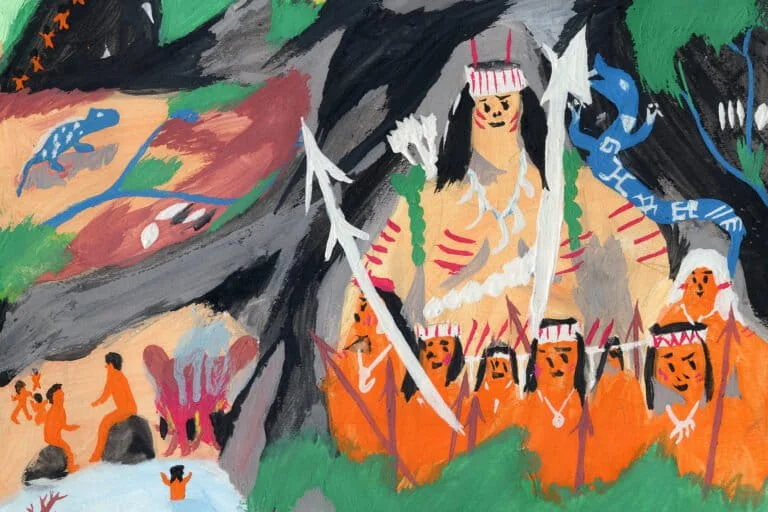
What the forest canopy conceals
Suriname’s rainforest can look untouched from above, but archaeological evidence tells a more complicated story. Renzo Duin, an archaeological anthropologist, found signs of long-standing human presence in the country’s inland highlands—evidence that could reshape how the region’s history and conservation are understood. The distinction matters: a forest that appears wild today may still carry traces of generations of human activity, even when those traces are difficult to see from the air or at ground level.
That doesn’t mean the forest was transformed everywhere in the same way, or that every archaeological trace tells a complete story. It does mean that “pristine” can be a misleading description when it treats the absence of visible modern development as proof that people were never there. Archaeology asks a different question: what evidence remains of earlier lives, and what might it reveal about how people moved through and understood these places?
Here’s the thing: the answer can affect more than how a region’s past is described. It can also influence which histories researchers pursue and what conservation planners consider when they make decisions about land and heritage.
Traces beneath the forest
During a 2004 expedition to the mountainous border region shared by Brazil, Suriname and Guyana, Duin joined French botanists and ecologists studying biodiversity. As the team mapped vegetation they viewed as pristine, he spotted pottery fragments and other signs of pre-Columbian occupation, including a site enclosed by a ditch. The discovery came during work focused on the living forest, a reminder that ecological surveys and archaeological investigation can encounter different kinds of evidence in the same terrain.
Pottery fragments are small pieces of a much larger record. They can indicate that people used a place, but by themselves they don’t establish how many people lived there, how long they stayed, or what their lives were like. A ditch enclosing a site adds another kind of clue: it points to a deliberate feature in the landscape, though the available account doesn’t establish its original purpose. Those limits matter. The evidence supports a history of human presence; it doesn’t license a detailed reconstruction of daily life.
Duin returned to the area over the following years, contributing to a broader shift in understanding: the Amazon rainforest across Suriname and the Guianas was inhabited and shaped by people over millennia. Archaeological work in the region has also documented rock art, stone tools and pottery. Taken together, these forms of evidence offer researchers multiple ways to investigate the past, from objects people made and used to marks left on rock surfaces.
Each kind of evidence has its own blind spots. Objects can survive unevenly, sites can be hard to locate under dense vegetation, and the presence of a material trace doesn’t always explain its meaning. That makes repeated fieldwork and careful comparison important. A single find can challenge an assumption, but a broader account depends on connecting many observations without claiming more than they support.
A large gap in the record
Research on Amazonian history has advanced substantially in Brazil, Ecuador and Bolivia over the past three decades, Duin said. In Guyana, Suriname and French Guiana, knowledge has grown along the coast and major rivers. The inland uplands, however, remain far less studied. “We have barely scratched the surface regarding the long-time histories of the Indigenous peoples,” he said.
That uneven record shapes what can be said about the region. Where research is concentrated along coasts and rivers, the inland highlands are less likely to appear in accounts built from available archaeological evidence. The gap doesn’t prove that the uplands lack important sites; it shows that the history documented so far is incomplete. Similar research gaps can arise when terrain is difficult to access or when fieldwork has focused on other parts of a region.
For readers, the key distinction is between a lack of evidence and evidence of absence. If you're working in this space, that distinction can guide how you read maps, surveys and claims about what a forest has or hasn’t contained. Researchers still need to establish what sites exist, how they relate to one another and what conclusions the material can bear.
 Duin in the Tumuc-Humac Mountains. Image by © 2004, Renzo Duin /AMIK.
What the evidence means for conservation
The findings complicate the idea of rainforest as an untouched wilderness. A fuller account of Indigenous history in the inland highlands may help conservation efforts reckon with the human past embedded in these forests. This is more significant than it looks: a conservation story that leaves out people who lived in a region can make the forest’s history seem simpler than the evidence suggests.
That said, archaeology alone can’t prescribe how conservation should work. The findings described here don’t specify a particular policy or management approach. They do make a case for including historical evidence in discussions of the forest, alongside the biodiversity research that first brought Duin to the area. The two forms of inquiry answer different questions, and both can help build a more grounded account of what a place is.
(And this is the part most people overlook.) A record that’s still sparse calls for care in both directions: it’s premature to treat the uplands as historically empty, and it’s also premature to fill the gaps with confident stories unsupported by evidence. Better documentation can sharpen the picture over time. For now, uncertainty is part of the story.
A forest can be ecologically rich and historically inhabited. Those facts don’t cancel each other out. The challenge is to describe the region without turning “untouched” into a shortcut that erases Indigenous histories, or turning a handful of archaeological traces into conclusions they can’t support. More research could clarify how people used the inland highlands across long stretches of time, but the source material here establishes the need for that work more clearly than it answers every question.
Still, a useful starting point. The evidence Duin encountered gives researchers a reason to look more closely at a part of the Guianas whose past remains poorly documented. What this means for you as a reader is straightforward: when a rainforest is described as pristine, ask what that label leaves out—and what evidence researchers have actually found.
This article was originally published on Mongabay.



Discussion
Sign in to join the discussion.