Two University of Surrey studies examine how Stoke Park’s green space affects heat, pollution and noise inside and beyond the park.
A park with effects beyond its boundaries
Stoke Park’s value to Guildford extends beyond recreation. Two recently published studies find that the park’s green spaces reduce heat, pollution and noise, and that their effects reach beyond the park itself. The findings put a familiar town amenity into a wider discussion about how urban greenery may influence conditions across a built-up area.
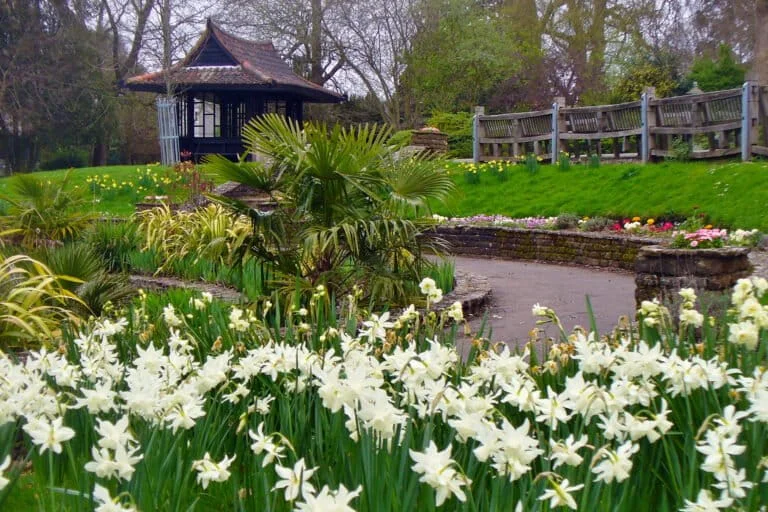
The 52-hectare (130-acre) site sits in Guildford, Surrey, and includes fields, ornamental gardens, a pond and mature trees. Those features make it a useful place to examine several kinds of green space within one park. They also make clear that “green space” isn’t a single uniform thing: the mix of open ground, water and trees matters to what researchers can study, even when the source findings don’t establish which feature contributes most to each effect.
Why measure several effects together?
Earlier research has found that parks tend to be cooler than nearby built-up areas and can lower air pollution and noise. Temperature reductions have also been measured tens or, in some cases, hundreds of metres from green spaces, depending on the park. That variation matters: a result from one site can’t simply be assumed to apply in the same way to another.
Researchers have often examined these benefits separately. A study focused on temperature can describe cooling, while another may assess pollution or noise; each offers a partial view of how greenery relates to conditions around it. Looking at several effects together makes it possible to ask a broader question: how do different environmental benefits overlap in one place, and how far might they extend?
That’s the case for studying Stoke Park as more than a patch of greenery on a map. The work brings heat, pollution and noise into the same account, while highlighting that the park’s influence may cross its formal boundary. It doesn’t, by itself, tell us how much each effect matters to every resident or how the results compare with other parks.
A wider frame for urban greenery
“Most of the work in this field has been focused around one benefit — so either you see just health benefits, or how they affect air pollution, or overheating,” Prashant Kumar, a University of Surrey professor and co-director of its Institute for Sustainability, told Mongabay. Kumar also directs the university’s Global Centre for Clean Air Research. He said few studies assess the multiple benefits of plants together.
The distinction is useful. When environmental effects are studied in isolation, decision-makers and residents can end up with separate pieces of evidence that don’t show how the pieces relate. A combined assessment can provide a fuller basis for discussion, though “fuller” doesn’t mean complete: the reported findings still need to be read for what they measure and where they apply.
Here’s the thing: the idea that a park can affect its surroundings is more significant than it looks. A park’s practical value may not stop at the point where paths and lawns give way to streets and buildings. If you're working in this space, that makes the area around a green space part of the question, not just the park’s internal features.
Stoke Park as a living laboratory
The findings position Stoke Park as a town-wide “living laboratory” for studying how green space can help address climate extremes. The phrase points to the value of examining a real park in relation to its surrounding town, where green and built environments meet. That setting can help researchers consider effects beyond the park boundary rather than treating the site as an isolated island.
And yet, the label shouldn’t be mistaken for proof that one park offers a ready-made template for every town. The existing research described here says that cooling distances vary by park, and the studies identify Stoke Park’s effects on heat, pollution and noise. The article doesn’t provide measurements that would establish how those effects differ across seasons, locations within Guildford or other kinds of urban green space.
That’s a limit, but it’s also a reason to keep studying the question. Similar assessments can help clarify whether effects observed at one site are shared by other parks, and which conditions shape their reach. The useful lesson isn’t that planting greenery guarantees a particular result; it’s that measuring several benefits together can give a more grounded account of what a park contributes.
What the findings mean for the town
For Guildford, the studies offer a practical reason to consider urban greenery as part of the wider town, rather than only as a place for recreation. Heat, pollution and noise don’t necessarily stop at a park’s edge, so assessing nearby areas can help describe the relationship between the green space and its surroundings. The reported reach beyond Stoke Park gives that wider view a concrete local basis.
The numbers here are underwhelming in one respect: the source doesn’t give the size of the reductions or a precise distance for each effect. Without those details, readers can’t judge the scale of the benefits or compare them directly. The findings still establish why the question deserves attention, but they don’t settle how much difference Stoke Park makes to conditions across Guildford.
For now, Stoke Park’s strongest significance is as a place to study combined effects in context. Its fields, gardens, pond and mature trees sit within a town, giving researchers a setting to examine how green space and built areas relate. More evidence across sites would help show how broadly the findings apply. A useful starting point, not a final answer.
This article was originally published on Mongabay



Discussion
Sign in to join the discussion.