Pak Mun Dam displaced families and reduced fish catches, while Sompong Viengchan and other women continue to press for justice.
A dam’s promise and its cost
The Pak Mun Dam was presented as a route to prosperity, but communities along Thailand’s Mun and Mekong rivers have lived with a more complicated result. Sompong Viengchan, now in her mid-70s, has spent decades challenging the cost imposed on those communities. Her activism has continued through changes in national government, outlasting 16 prime ministers and 26 cabinets. That persistence says something about the dispute: it hasn’t been settled by the passage of time or by changes in political leadership.
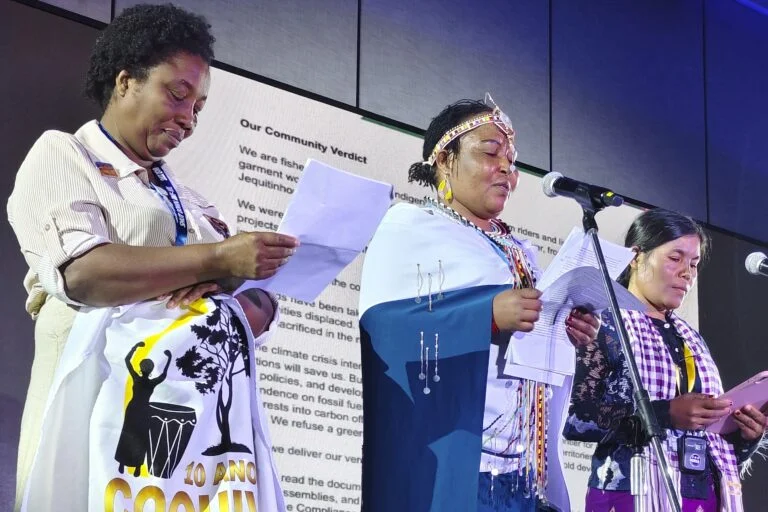
Since 1990, Sompong and her neighbors have argued that the 136-megawatt multipurpose dam, co-funded by the World Bank Group, damaged the fishing livelihoods on which local families depend. Their claim connects a large infrastructure project to the ordinary conditions that make village life possible: access to fish, the ability to earn a living close to home, and the choice to remain in a community. These consequences can be harder to capture than a project’s generating capacity, but they’re central to how people experience development. At an October people’s tribunal in Bangkok, Sompong shared that experience with 400 women land defenders from more than 30 countries. The gathering examined the social and environmental impacts of projects funded by the IMF and World Bank, placing the Pak Mun dispute within a wider conversation about who bears the costs of major development schemes.
What changes when fishing is disrupted
“Living in the village downstream with no agricultural land, we rely primarily on fishing,” Sompong said. Her account makes clear why a fall in fish catches can reach far beyond the water. When a household depends mainly on fishing and has no farmland to fall back on, damage to that livelihood can affect food, income, debt, and whether family members can stay in the village. The effects aren’t neatly separated into an environmental problem and an economic one. They become part of daily life.
Sompong described fish losses after construction blasting, household debt, families sending children to cities for work, and community relocation when flooding inundated the area. Those details trace a chain of disruption rather than a single, isolated harm. Debt can narrow a family’s choices; work elsewhere can separate households; relocation can break the link between a community and the place where its members have built their lives. The account doesn’t provide a full tally of each consequence, and it shouldn’t be stretched into one. But it does show how residents understand the relationship between the dam and the changes they’ve faced.
Fish losses are the most direct measure in that story. The wider implications are harder to count. A change in where families work, how they manage debt, or whether they can remain in their homes may not appear in a project’s headline capacity. Yet those are the outcomes residents have to navigate. Here’s the thing: infrastructure can be described in megawatts, while the cost to a household is felt in the work it can still do and the choices it has left.
What the assessment found
A 2000 assessment by the World Commission on Dams, established by the World Bank and IUCN, found that about 1,700 households lost homes, land, or both. Fish catches in the reservoir and directly upstream had fallen by 60% to 80%. Those findings give scale to the losses described by Sompong and her neighbors. They also make the dispute about more than an individual account: the assessment documented substantial changes to homes, land, and fishing in areas affected by the project.
The figures don’t tell every part of the story. They don’t, on their own, explain what relocation meant for particular families, or how a decline in fishing shaped household decisions over time. Nor should a single assessment be treated as a complete record of every experience along the rivers. Still, it supplies a concrete basis for understanding why residents have continued to press their case. When reported losses reach thousands of households and catches fall sharply, communities have reason to ask how the costs were weighed against the promised benefits.
That question matters for any large project that changes access to land or water. Similar disputes often turn on whether the benefits described at the planning stage match the effects residents encounter afterward. The Pak Mun account offers a clear example of why those assessments need to take livelihoods seriously. The numbers here are striking, but numbers alone don’t settle what should happen next.
Who gets a say in development?
“Building a dam is the same as burying a person alive,” Sompong said. It’s a severe comparison, and it carries the force of a person describing a project through the loss of livelihood, home, and control over daily life. The phrase shouldn’t be mistaken for a technical description of the dam. It’s a statement about what development can feel like when the people living with its consequences believe their needs weren’t given enough weight.
Her account frames the movement’s central demand: development projects should answer to the people whose livelihoods they reshape. That demand goes beyond asking whether a project produces power or serves multiple purposes. It asks who decides what counts as a benefit, who bears the damage, and whether affected communities have meaningful influence over those decisions. And this is the part most people overlook: being consulted and having a say in the outcome aren’t necessarily the same thing.
This is more significant than it looks. The movement has endured across decades of government turnover, while its central concerns remain tied to fishing, land, debt, and displacement. That persistence suggests the consequences described by residents haven’t been resolved simply because the project has been built or because the political setting has changed. The conflict remains part of the community’s life.
If you’re working in this space, the case is a reminder that project performance can’t be judged only by the purpose named for a dam. Local livelihoods and the experiences of displaced families belong in the account too. That said, the source doesn’t establish that every community member shares the same view, or that one account captures every impact. It does provide a sustained challenge from residents, backed by an assessment reporting large losses to homes, land, and fish catches.
For Sompong and her neighbors, the demand is plain: people whose lives are reshaped by development should have a voice in how it is planned and judged. The hard part is making that principle count when the consequences are unevenly distributed. A project can promise prosperity. The test is who gets to define it—and who is left carrying the cost.


Discussion
Sign in to join the discussion.