Women-led businesses in rural Nepal support family incomes and offer alternatives to forest-based livelihoods.
Income and independence
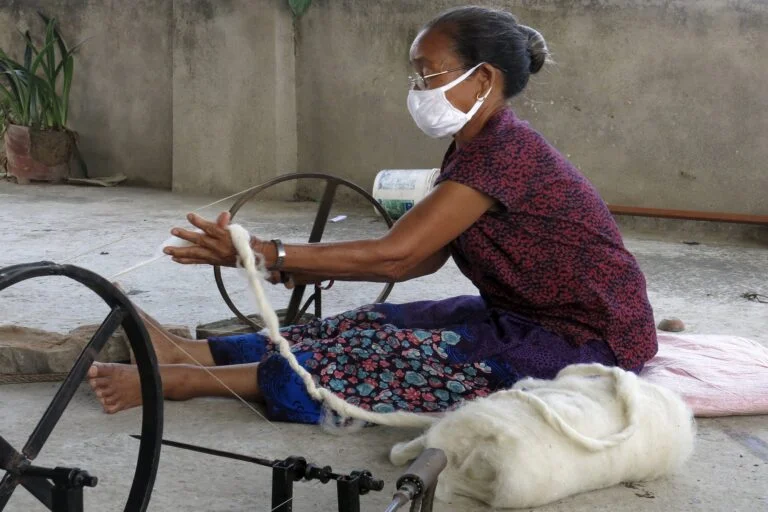
Women-led microenterprises in rural Nepal can connect household income with reduced pressure on forests. In Naya Padampur, Bin Maya Gurung’s wool-spinning business grew from skills she began learning in the early 2000s. Today, she works at a rooftop spinning wheel in the enterprise that helps support her family. The account offers a useful view of how a small business can fit into daily life: a learned craft becomes a source of earnings, and those earnings contribute to a household’s finances. It doesn’t establish that every enterprise will have the same effect, but it shows why access to practical skills and a chance to earn can matter.
Across Nepal, more rural women have entered business over recent decades as government rules and social norms shifted. The financial gains can strengthen women’s confidence: a 2022 study in Parbat district found that 96% of women involved in microenterprises felt able to support their families with their earnings. That finding describes the women surveyed in one district; it shouldn’t be treated as a measure of every rural woman’s experience or as proof that all businesses are profitable. Still, the result points to something beyond cash flow. When women can contribute earnings, they may have a stronger sense of agency within the household and a clearer role in decisions about family needs.
Microenterprises are often small in scale, but their value isn’t captured by size alone. A household business can build on skills already present in a community, while offering an income source that doesn’t depend solely on farming or gathering and selling natural materials. The work may also be compatible with other responsibilities, though the source doesn’t describe how Gurung divides her time or what conditions shape her business. That missing detail matters: an enterprise can offer independence while still relying on unpaid household labor, access to materials, and the ability to reach buyers.
Here's the thing: earning money is only part of what makes a livelihood durable. A business also needs customers, reliable inputs, and enough room to operate when household demands change. The account of Gurung’s spinning business gives a human example of a livelihood taking shape over time, but it doesn’t tell us how large the enterprise is, how much it earns, or whether other workers are involved. Those limits don’t diminish the example; they set the boundaries of what it can show.
A livelihood with conservation benefits
For rural households, small businesses can bring income beyond the sale or use of forest products such as timber. That gives women’s enterprises a role in easing reliance on forests while building local livelihoods. The experience in Nepal reflects a wider connection between women’s economic participation, community well-being and conservation. The connection is plausible, but it depends on the alternatives available to households: an additional source of earnings can reduce pressure on forests only if it helps meet needs that would otherwise be met through forest use.
That distinction is important. Forests can provide materials, fuel, food, and income, and households may depend on them in different ways. A business based on a craft or other locally available skill could diversify those sources of support. Yet a microenterprise doesn’t automatically replace forest-based livelihoods, nor does the source establish a measured reduction in forest use in Naya Padampur. The conservation benefit is best understood as a potential pathway: when families have more ways to earn, they may have less need to rely on forest products for every household requirement.
Wool spinning makes the point concrete without proving more than the account supports. Gurung’s business draws on a skill she began learning years ago and now contributes to her family’s support. If you're working in this space, the question is how such enterprises can remain viable while fitting local conditions. Access to skills is one part; obtaining materials, finding buyers, and retaining a fair share of the value are also common considerations for small producers. The account doesn’t specify how those factors work in Gurung’s case, so they’re questions for further reporting rather than established facts about her business.
(and this is the part most people overlook) A conservation strategy built around income needs to pay attention to who controls the earnings and who bears the work. If women take on business responsibilities without gaining meaningful influence over the money or their time, the household benefit may be less transformative than the headline suggests. The study’s finding about women feeling able to support their families offers a measure of perceived contribution, but it doesn’t answer every question about decision-making, workload, or long-term security.
What the example can—and can’t—tell us
The article presents two related ideas: women’s participation in microenterprise can support families, and alternative income may ease pressure on forests. They reinforce each other, but they’re not interchangeable claims. A study finding from Parbat provides a specific indication of how surveyed women viewed their earnings. Gurung’s story provides a local example of a business rooted in skills developed over time. Neither, by itself, establishes how widespread the benefits are or how much forest use changes.
That said, the combination is more significant than it looks. Income, confidence, and conservation are often discussed separately, even though rural households experience them together. A source of earnings can affect how a family meets its needs; those choices can, in turn, shape its dependence on natural resources. The chain isn’t automatic, and the effects will depend on the business and its context. But it gives policymakers and community organizations a reason to consider women’s enterprises as part of livelihood work, rather than treating them only as small commercial projects.
For readers, the useful takeaway is measured rather than sweeping: microenterprises can create options. Their contribution will depend on whether women can build on their skills, earn from their work, and sustain the business over time. A rooftop spinning wheel is a modest image, but it captures the practical scale at which economic change may begin. Not a universal model. A livelihood, built through work and experience.
Implications for livelihoods and conservation
The next question is whether the conditions that support one enterprise can be understood well enough to help others. That means looking beyond the fact that a business exists and asking what enables it to continue: skills, materials, customers, household support, and the ability to keep earnings connected to women’s work. These are general considerations for rural enterprises, not details supplied about Gurung’s operation. Reporting on them would help explain whether the benefits described here are durable or depend on circumstances that may be difficult to reproduce.
Conservation efforts also need to distinguish between offering a new income source and demonstrating a change in forest use. The former may create a route toward the latter, but evidence of the link requires attention to what households use forests for and how their choices shift as livelihoods change. Without that detail, it would be premature to claim a direct conservation outcome from a single enterprise. The more careful conclusion is that women-led businesses can support family income and may help broaden livelihoods beyond forest products.
For rural communities, that possibility is meaningful. When women can turn skills into earnings, their contribution to family support becomes visible in a different way, and households may have more than one source of income to draw on. Whether that also eases pressure on forests will depend on the local economy and the alternatives available. The case from Nepal is a reason to pay attention to those connections—and to gather the evidence needed to understand how far they extend.
This article was originally published on Mongabay



Discussion
Sign in to join the discussion.