Amid escalating wildfires in Indonesia, local rubber farmers are relying on traditional methods to protect their livelihoods from the flames.
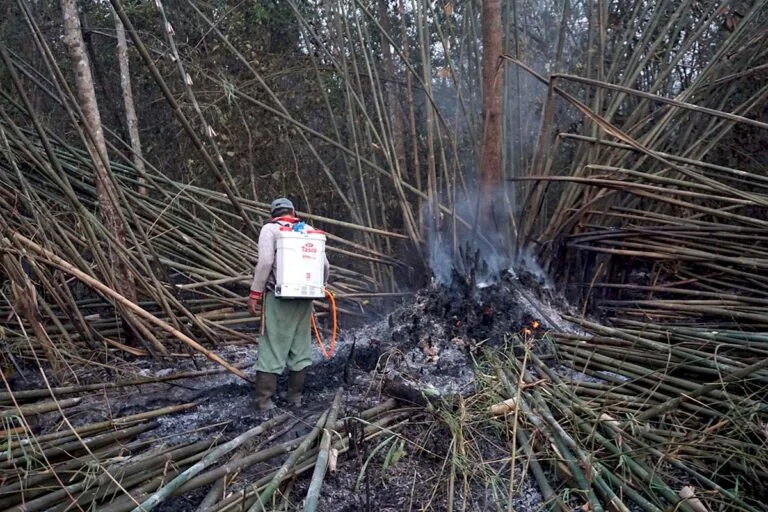
PENUKAL ABAB LEMATANG ILIR, Indonesia — On September 5, Sumanti sped along her motorcycle as flames leapt across the dry underbrush, threatening her family's rubber tree farm. Frantic calls for help went unanswered as the wildfire surged closer. “The fire is already approaching our land,” she exclaimed, her voice filled with urgency as she sought her family.
Within 30 minutes, her relatives mobilized, surrounding the advancing flames with 35-liter (9-gallon) water canisters and a sprayer typically reserved for distributing fertilizer. The family, consisting of four members, worked tirelessly, hauling water from a dwindling paye—a freshwater source—hidden among the rubber groves. Despite hours of effort, they faced increasing difficulty as the fire continued to break through the surrounding bamboo and brush.
Impact of Drought and El Niño
This struggle is emblematic of broader challenges faced by local communities, particularly those like Sumanti's family, who depend on rubber cultivation and latex production in Talang Turunan Gajah, a small hamlet in Tempirai village, South Sumatra Province. The increasing frequency and intensity of wildfires in this region have drawn a direct line to the effects of climate change and the El Niño phenomenon, which significantly alters weather patterns across the globe. Typically, El Niño brings hotter and drier conditions to Indonesia, exacerbating the risk of wildfires.
In many areas, traditional agricultural practices are under threat. For families reliant on rubber trees, the cost of losing even a portion of their crops can be devastating. The region has always faced fire risks; however, changing weather patterns are amplifying these threats. The cumulative effects of prolonged drought conditions mean that the ground becomes parched, turning it into a tinderbox just waiting for a spark. Sumanti and her family are not an anomaly; they represent countless others whose livelihoods are at stake as drought conditions worsen.
The economic ramifications of the fires stretch far beyond the local villages. Smoke from these burning forests drifts across national borders, contributing to poor air quality in neighboring Malaysia and Singapore. These regions often experience the harsh effects of haze during these periods, impacting health and well-being for millions. What's even more alarming is how this environmental crisis complicates existing socio-economic structures. People who may have once relied on neighboring nations for trade or support now find themselves in competition for dwindling resources such as clean air and healthy crops.
Traditional Responses to Modern Problems
Facing such an overwhelming crisis, families like Sumanti's are compelled to use traditional firefighting methods, mixing modern tools and old practices to protect their land. The efficacy of these methods often falls short against raging wildfires. While hauling water from a paye may have sufficed in the past, the intensity and spread of current fires introduce a level of urgency that traditional techniques struggle to meet. Firebreaks, controlled burns, and community mobilization have historically been effective, but as conditions worsen, these strategies may need reevaluation.
That said, local wisdom and community efforts play an essential role in fighting these fires. Families who have farmed this land for generations often know the terrain intimately, allowing them to act quickly and efficiently in times of crisis. But the long-term sustainability of these methods is questionable when faced with increasingly severe climate crises. More support, both in terms of training and resources, is crucial if local farmers are to withstand the pressures of these changing environments.
Implications for Future Resilience
It's clear that growing incidences of wildfires and changing climatic conditions invite questions about resilience in agricultural practices. Families like Sumanti's may benefit from government and NGO interventions aimed at improving firefighting capabilities, enhancing water conservation practices, or introducing crops that are more resilient to climate extremes. These changes are not just beneficial; they are necessary if rural communities want to thrive in a changing world.
What this means for you, especially if you're working in agricultural policy or environmental management, is the importance of integrating traditional practices with modern solutions. Supporting local communities not only helps them survive but can lead to partnerships that foster innovation in sustainable agriculture. Opportunities exist to educate communities about better environmental stewardship while respecting their cultural practices. And here’s the part most people overlook: these families are not just victims of climate change; they’re active participants in the fight against it.
Local adaptations to changes, while commendable, can't cover the scale of the issue on their own. Climate change is here to stay, and unless there’s a coordinated effort to address its root causes, the fires that currently threaten farms like Sumanti's could become the norm rather than the exception. The stakes are high; without sufficient support, livelihoods hang in the balance, and a way of life could be extinguished alongside the flames.
Image by Muhammad Akbar/Mongabay Indonesia. This article was originally published on Mongabay.



Discussion
Sign in to join the discussion.