After recording more than 5,000 hours of natural sound, a field researcher sent the archive to France to safeguard a record of ecological change.
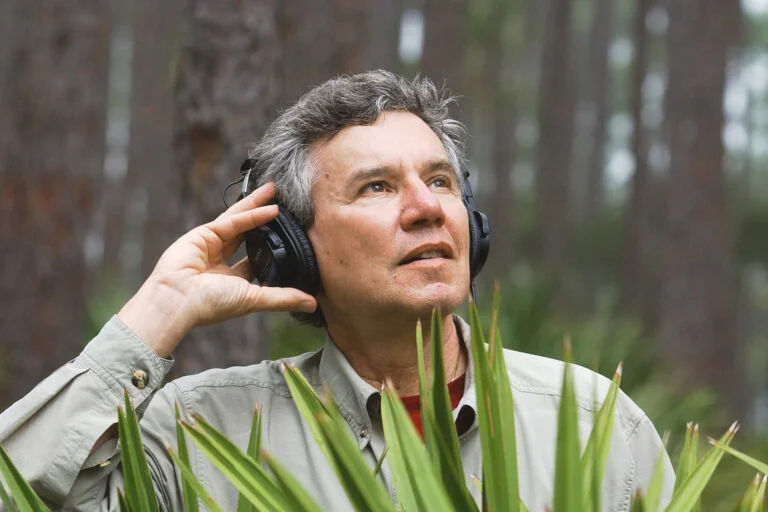
More than 5,000 hours of recordings gathered over half a century capture a changing natural world: its vivid sounds, and their decline. Sending the archive to France reflects a growing responsibility for soundscape ecologists: preserving the evidence of life’s collective voices before it disappears. The recordings are more than a store of striking noises. Taken together, they offer a way to compare what places sounded like across years and environments, including changes that might be difficult to grasp from a single visit or a written description.
A record of ecological change
Wind, water, leaves and animals form more than an evocative soundscape. Recorded over time, these biophonies can serve as lasting records of planetary health, alongside genetic databases and satellite images. The collection spans marine and terrestrial environments, holding evidence of both abundance and loss. Its breadth matters because sound is shaped by many parts of an ecosystem at once: animal calls, weather, moving water and the physical character of a place all contribute to what a recording captures.
A recording is a snapshot, but a long-running archive can make snapshots comparable. Researchers may listen for the presence or absence of particular calls, changes in how frequently sounds occur, or shifts in the balance between animal activity and background noise. Those comparisons don’t automatically explain why a sound changed. They can, however, give scientists evidence to investigate alongside other observations, such as habitat records or biological data.
Sound has a particular strength as a record because many species communicate acoustically, and their calls can reveal activity that isn't readily visible. At the same time, a microphone doesn’t provide a complete account of a place. It records from a particular position, under particular conditions, and it can miss organisms that are quiet, distant or outside its range. The value of an archive depends partly on retaining that context: when and where material was collected, and how it can be compared with other recordings.
That makes a collection spanning marine and terrestrial settings useful in a way a single site’s recordings can’t be. It brings together different acoustic environments and preserves material that may support questions researchers haven’t yet asked. A reference point for later listening. The evidence is audible, but its meaning still depends on careful interpretation.
Preserving the record
In 2017, weeks after a new U.S. administration took office, researchers described science being treated with suspicion, funding cuts and datasets disappearing from public view. The episode sharpened concerns about preserving scientific records: damage could mean losing not only habitats and individual species’ calls, but also the knowledge built from decades of observation. Data archives are easy to overlook when they’re functioning; their importance becomes clearer when access is threatened or the work needed to maintain them is interrupted.
Preservation involves more than keeping a copy of a sound file. Researchers need recordings to remain accessible and interpretable, with enough information to understand their origins and limitations. An archive that survives but loses its accompanying records may be far less useful to future study. And a collection that can’t be found or heard by other researchers risks becoming evidence in name only.
The researcher copied the field collection and sent it to France, acting from a sense of duty as well as defiance. The archive’s value lies in what it can help preserve: a record against which future changes in the natural world can be heard. Moving a copy across a border can also make preservation less dependent on a single institution or national setting, though it doesn’t remove the ongoing work of caring for the material and keeping it usable.
This is more significant than it looks. Scientific archives often gain value over time, as new methods and questions make old observations useful in ways their collectors couldn’t have anticipated. A half-century of recordings holds that possibility. It also makes the loss of the collection difficult to repair: a later recording can document a place as it sounds then, but it can’t recreate what was heard decades earlier.
What the recordings can—and can’t—tell us
Soundscape records can help researchers notice patterns, but they shouldn’t be treated as a simple score of ecological health. A quieter recording might reflect fewer animals, a change in weather, a different recording position or some combination of factors. Likewise, a busy soundscape doesn’t by itself establish that an ecosystem is healthy. The recordings are evidence, not a verdict; their strongest use comes from comparison and interpretation.
That distinction matters to anyone encountering the archive beyond the research community. A vivid recording can make environmental change feel immediate, but one clip can’t stand in for a full ecological assessment. Long-term collections offer a more disciplined way to ask what has changed, where, and over what period. They let listeners compare evidence rather than rely on memory alone.
Here's the thing: preserving the archive protects options for future research. The next generation may have better ways to analyze recordings, or may ask different questions about the relationships between species and their environments. If you're working in this space, the lesson is practical: collection and preservation belong to the same scientific effort. Recordings need to be kept with the information that gives them meaning, and made available in forms that allow others to build on them.
The value of listening over time
Sending the collection to France is a response to a specific concern about the safety of scientific records. Its broader significance is that environmental evidence takes many forms, and sound deserves a place among them. Satellite images show patterns across land and water; genetic databases preserve biological information. Recordings capture another dimension: the audible presence of life and its surroundings at particular moments.
That record can’t stop ecological decline or restore sounds that have vanished. It can give researchers and the public a basis for recognizing change, and help preserve knowledge that would otherwise be difficult to recover. The archive’s story also points to a plain responsibility: observations gathered over decades are valuable only if someone continues to care for them. The sounds may fade from the places where they were recorded. The evidence doesn’t have to vanish with them.
This article was originally published on Mongabay.



Discussion
Sign in to join the discussion.